Wednesday, May 4, 2011

 Taj Mahal


Taj Mahal is regarded as one of the eight wonders of the world, and some Western historians have noted that its architectural beauty has never been surpassed. The Taj is the most beautiful monument built by the Mughals, the Muslim rulers of India. Taj Mahal is built entirely of white marble. Its stunning architectural beauty is beyond adequate description, particularly at dawn and sunset. The Taj seems to glow in the light of the full moon. On a foggy morning, the visitors experience the Taj as if suspended
. when viewed from across the Jamuna river 


Orchard cardamom


This resort is located about 20 km from Thekkady Teguedi in the wayTo Munnar and specifically in the village, which is Vandanmedu Hill, the largest producer of Cardamom in the world. And that place is characterized by its altitude 4000 feet above sea level (1200 meters), which gives a more tropical air of cool and makes Breathing air fun of itself 


The Indian Himalayas


The arc-shaped Himalayas extend along the entire northern boundary of India and carve just as far across the Indian subcontinent as they do deeply into the life around them. was coined by the Indian pilgrims who traveled in 
.these mountains in ancient time


Strange customs


Strange customs in India , such as: 


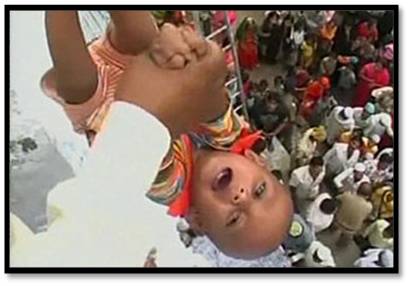
1-Throwing children:
 Throwing children over the buildings more than once and they that believe it makes the child a fortunate and enjoy Good health in his life .


 2- sati:

Sati is the practice through which widows are voluntarily or forcibly burned alive on their husband's funeral pyre. It was banned in 1829, but had to be banned again in 1956 after a resurgence. There was another revival of the practice in 1981 with another prevention ordinance passed in 1987 (Morgan 1984). The idea justifying sati is that women have worth only in
. relation to men 


:Some India discoveries


:a-Choerer, iron and mercury

In 1899, the Bengali physicist Jagdish Chandra Bose announced the development of an "iron-mercury-iron coherer with telephone detector" in a paper presented at the Royal Society, London. He also later received U.S. Patent 755,840, "Detector for electrical disturbances" (1904), for a specific electromagnetic
. receiver   


:b-Crescograph   


The crescograph, a device for measuring growth in plants, was invented in the early 20th century
. by the Bengali scientist Jagdish Chandra Bose 


c-Stupe


The origin of the stupa can be traced to 3rd century BCE India. It was used as a commemorative monument associated with storing sacred relics.The stupa architecture was adopted in Southeast and East Asia, where it evolved into the pagoda, a Buddhist monument used
 .for enshrining sacred relics

Tuesday, May 3, 2011


:Some  India inventions 


       Agriculture


:a-Cashmere wool    


The founder of the cashmere wool industry is traditionally held to be the 15th century ruler of Kashmir, Zayn-ul-Abidin, who employed weavers from Central Asia.


:b-Cotton 
Cotton was cultivated by the inhabitants of the Indus Valley Civilization by the 5th millennium BCE - 4th millennium BCE.The Indus cotton industry was well developed and some methods used in cotton spinning and fabrication continued to be practiced
. till the modern Industrialization of India


2- Mathematics:


  :a- Algebraic abbreviations
The mathematician Brahmagupta had begun using abbreviations for unknowns by the 7th century. He employed abbreviations for multiple unknowns occurring in one complex
. problem


:b - Basu's theorem  


The Basu's theorem, a result of Debabrata Basu (1955) states that any complete sufficient statistic is independent of any ancillary statistic


3- Medicine:


:a-Stones

The earliest operation for reemoval of a stone is also given in the Sushruta Samhita (6th century BCE).[169] The operation involved exposure and going up through the floor of the bladder.


b-Ayurveda:
Traditional system of medicine dating back to Iron Age India (1st millennium BC) and still practiced today as a form of complementary and alternative medicine. Means "knowledge for longevit.

home


location 
History of India
 India  Relieigons
Clothing
Economy
Education
culture
Strange customs
 cities in india
 Touristic sites


India is a grand country. It is the seventh largest country in the world and the second most
.populated  country